Showing posts with label ruffle width. Show all posts

Sunday, April 14, 2013

Mock Croc, Scallop, or Shell-in-the-Yarn

Shell motifs is to crocheters as seed stitches are to knitters: a basic pattern of stitches that creates a small, textured motif in the finished work. They take little advanced knowledge and make the work go quickly. One of the most popular shell motifs today is the overlapping detached shell, also known as the crocodile stitch.


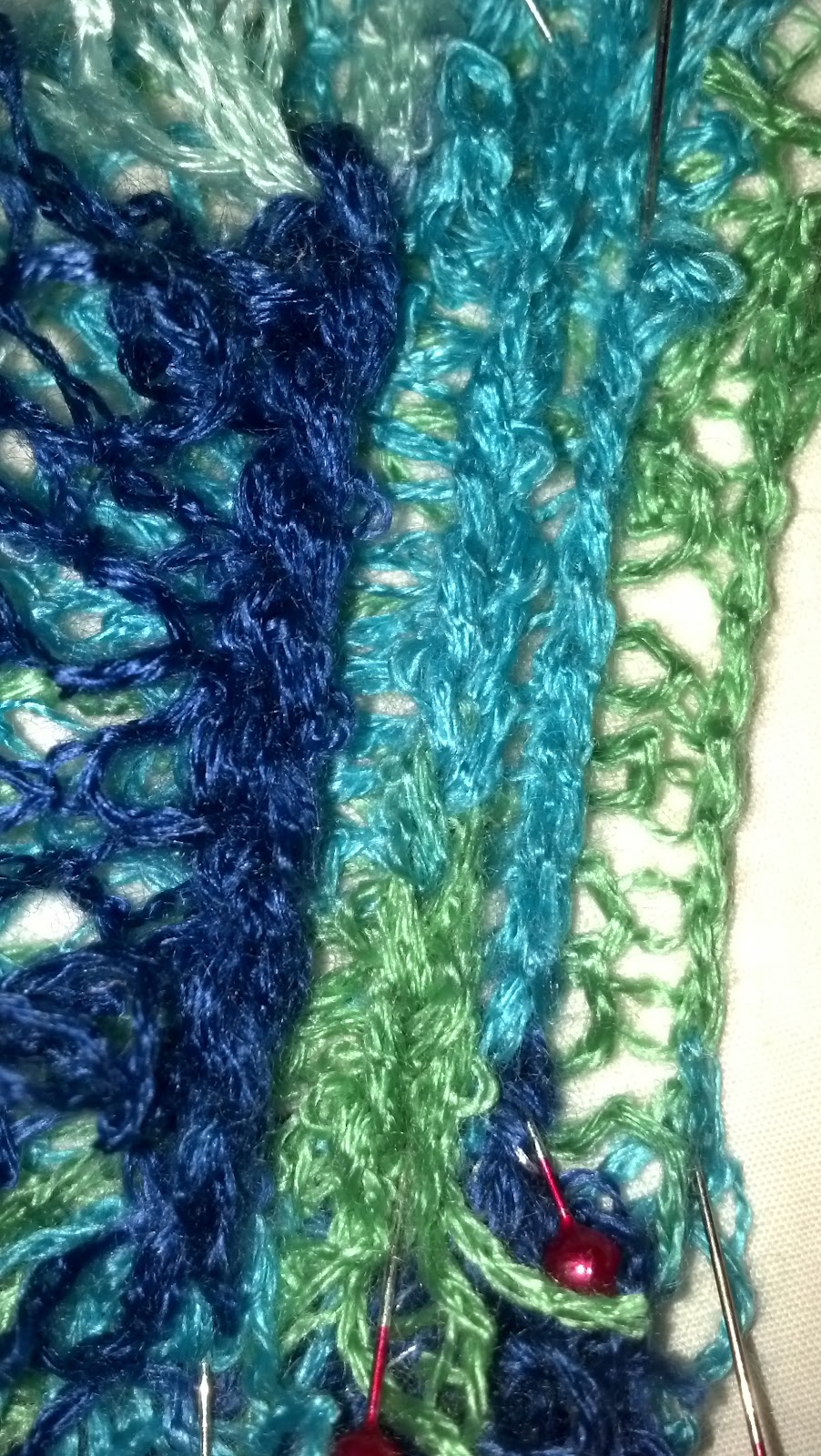
A similarly-scaled effect can be created in either knit or crochet by varying the number of threads we pick up each time we wrap the yarn over the hook or needle. The difference between this and ruching is that with the scallop stitch, we pick up all of the threads from the working edge through the indicated thread for the current wrap, rather than picking up only the thread of the current wrap. As I noted in a previous post, this will create a variable thickness in the working row; crocheters may need to use a larger hook to get the bulk of multiple working threads through the previous work. Conversely, knitters may need to use a smaller needle to manage working the multiple threads.

Single chain, Shell-in-Yarn, Starbella Flash
The basic method of working scallops is to pick up one additional thread on each stitch (or yarn-over) through the embellished edge, then one fewer thread on each stitch (or yarn-over) until only the working edge remains, and repeat.This works fine in a double or treble crochet and a wide mesh, in which the repeat may only take two or three stitches; it's a bit less obvious in knitting, where the repeat could take as many as twenty stitches.

Six rows knit scallop, Starbella Flash

One method of shortening this is to work with multiples of two, three, or more threads on each stitch.

I brought the pattern forward on the sample at right by working 1, 4, 7. all, 7, 4, 1 threads on an every third row pattern over 20 stitches. I brought all the scallops to the front of the work, and straight ruffles to the back, as follows:

R1, 2: knit
--start pattern--
R3: knit scallop row
R4: knit
R5: purl
R6: purl scallop row
R7: purl
R8: knit
--end pattern--

The scallops aren't precisely counterposed on this sample — I should have worked over 21 stitches to do perfect three-and-a-half pattern repeats: (1, 4, 7, all, 7, 4 for a six-stitch pattern)

A deeper scallop might be achieved by skipping one or more spaces between each yarn-over.


6-row scallop stitch pattern
In crochet, scallops can be sent to one side of the work using the ball front/ball back technique discussed in a previous post.

Friday, March 8, 2013

Changing the Ruffle Width

The mesh structure of ruffle yarns allows us to play with the width of the ruffle — that is to say, how far it stands out from the body of the fabric. In sewing, a narrower ruffling strip makes a narrower ruffle, and that's pretty much the end of it. (Unless you're ruching the strip, which is the subject of another post.)

We can create a narrower ruffle in two ways:
  1. We can work the first two, three, four, or more threads together into a thick working edge.
    Working the first, first two, first three, and first five threads of Sashay.
    Chain side of 5, 3, 2, and 1 worked threads

  2. We can make the second, third, fourth, or middle thread as if it were the working edge, leaving Thread 1 to form a second, often shallower, double ruffle.
Top to bottom: Chained 5th thread; chained first 5 threads together; chained first 3 threads together; chained 3rd thread