Showing posts with label spaces. Show all posts

Tuesday, February 26, 2013

Technique: Mitered Cast On and Bind Off

One method of hiding the raw edges on ruffle yarn is to work them into the bind on and cast off of a piece.

Casting On


Fold the raw edge diagonally so that the first row of alternate spaces meets the loops formed by Threads 1 and 2.
Match the loops to the alternate spaces. You may need to pin the openings to a padded board to keep them aligned.
Cast on or chain as usual, keeping the matched openings together.


Finishing Off

As you approach the end of your piece, count out the number of loops you need to bind off and/or finish the final row or round. You should do this when you require one or two loops more than the number of alternate rows on your yarn.
Cut the yarn with two or three loops more than you need to finish your work.

Fold the raw edge diagonally so that the first row of alternate spaces meets the loops formed by Threads 1 and 2. Be sure to make your fold so that the raw edge will end up on the inside of the work, rather than the outside (as I did in following photos).
You may need to transfer the matched loops to a cable needle or other holding needle to keep them in order as you finish the final row.
A third needle keeps the loops-to-be-worked straight

Continue to crochet, or to bind off, as usual. Finish and secure the threads and open loops at the working edge.
A mitered bind-off


Note that if I had folded the raw edge to the other side of the working edge, the raw edges at the top would have been hidden.

Counting Stitches: Alternate Spaces

Some patterns and techniques will require you to make use only of spaces in a pattern that is perpendicular to a particular loop -- say, to create a mitered corner or a traditional (bent at 45-degree angles) ribbon rose.
Depending upon whether your spaces are to start, you would use either the spaces defined by the capital letters below, or the spaces defined by the lower-case letters.


Or, in the theme we discussed earlier, usually the odd-numbered spaces, but occasionally the even-numbered ones.

Monday, February 25, 2013

Binding Off

Because ruffle yarns are looser than standard yarns, a typical bind-off will appear very tight. While this is fine (even desirable) for The Scarf, it's less useful if you are using ruffle yarn for the fancy edge of a garment.

The method that seems to work for Sashay is:
(k1, slip the knit stitch back to the left needle),repeat, k2 tog, (slip the knit stitch back to the left needle, ((k1, slip the knit stitch back to the left needle), repeat, k2tog)), repeat until only one stitch remains.


This is basically knitting each stitch twice before knitting it together with the next stitch. As you can see from the photo, this leaves a pretty straight edge, though there's still a bit of tightness to it.


A variation of the more standard bind-off (k1, (sl1, pass knit stitch over sl st, knit slipped stitch), repeat) had me knitting the same Sashay stitch three times before binding off


A larger mesh, such as Starbella, may require knitting each stitch three or four times before binding it off by knitting it with (or slipping it over) the following stitch.

Design Note:

The curvature of the traditional bind-off (knit each stitch once before slipping it over the next stitch) can also be used to create a collar (see this section of Premier Yarns' Cascading Ruffles scarf) that lays flat on the neck and shoulders, an armhole trim, or other curved trimming.


Saturday, February 9, 2013

Defining the Width: Rows and Spaces


Because some patterns and techniques may specify either collapsing several threads together to create a thicker working edge or working with interior spaces (spaces that are formed by openings between threads other than Thread 1 and Thread 2), we need a common way to refer to these threads and spaces..
Sashay has 10 threads plus an embellished edge

In Knockout Kreations' Simple Switchin' Headbands, Angelina refers to the spaces between two long threads as "rows of loops". While she begins numbering them from the embellished edge, it is more practical to number them from the working edge, since different yarns have different numbers of threads, and different arrangements of threads, across their widths.

I tend to look at the width-wise spaces of a  yarn through a line perpendicular to the yarn's length. For example, I see either three full spaces across the width of Starbella (marked A, B, and C), or four spaces (a, b, c, and d). Kind of confusing, right?
Starbella Flash has seven threads (plus an embellished edge) - but how many spaces?
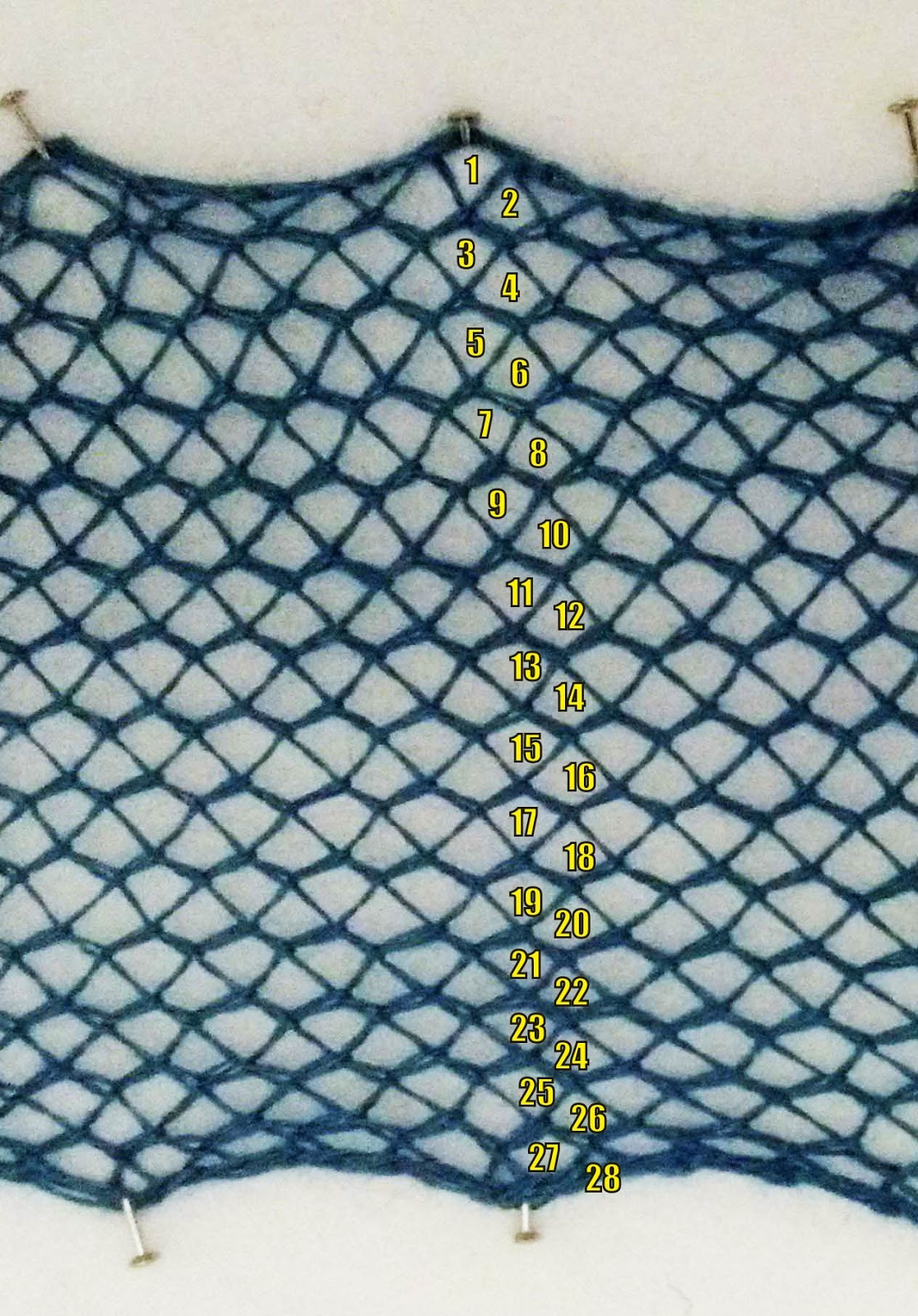
In the end, I think Angelina has the right of the count, while not of the order:  if we number our width-wise spaces based on the thread count, the confusion disappears, even if those spaces seem to progress in a zig-zag faxhion:
Starbella Flash - The threads are numbered yellow; the spaces, white.

Space 1 is formed by threads 1 and 2; space 2 is formed by threads 2 and 3; space 3 is formed by threads 3 and 4, and so on. By this method, Sashay has 10 spaces, Pirouette has 6, and the smaller-holed Twist & Twirl, 28.
Spaces in Sashay

Piroutte has six spaces
plus a three-row embellished edge

Twist & Twirl has 28 spaces


It may be easier to envision the spaces as forming a sort of diagonal across the width of the yarn, as you can see in this sample of Trendsetter Yarns' Flamenco.
Spaces in Flamenco (Trendsetter)

Thursday, February 7, 2013

Loops, Threads, Holes, and Spaces

The next thing we need to learn about ruffle yarns is how to refer to their internal structure.

When we look at ruffle yarns, we often look at them like we looked at sewing cards as children -- that is, we see specific holes into which we are supposed to insert our knitting needles and crochet hooks to make a scarf, shawl, or fancy trim.

Depending on who you talk to and the type of ruffle yarn you are talking about, these holes may be called "loops", "spaces", or "holes". Specifically, since fabric-based ruffle yarns have regular round holes punched in the manufacture of the yarn, the place-to-put-your-needle is very definitely a hole.
Tecido Trico (Sky Blue) by Knitting Fever
Most ruffle yarns are constructed several mutiple-ply threads that are connected to each other at evenly spaced intervals, alternating between the left-neighbor and right-neighbor threads.
Starbella by Premier Yarns
For ease of navigation, I propose numbering these threads, starting from the working edge, like thus:
Sashay by Red Heart
Starbella Flash by Premier Yarns
Most patterns for working ruffle yarns ask the needleworker to work with the portions of the working edge between its connections to Thread 2, asking her to place her needle through the "loop" or "space" created between two adjacent connections.  

My next post will deal with describing the yarn across its width.